
Determination of Precise Lattice Parameter of FCC and BCC phases using X-Rays diffraction
Laboratory Procedure:
Record the diffraction peak positions (2θ) from the XRD pattern.
Index the diffraction peaks by assigning the appropriate (h k l) planes corresponding to the FCC or BCC crystal structure.
Calculate the Bragg angle 2θ, θ, θ (in radians), sin θ, sin2θ, & cos2θ, and the interplanar spacing d for each reflection using Bragg's law.
Determine the lattice parameter a corresponding to each indexed reflection using the cubic lattice relationship:
a=d√(h2+k2+l2 ) Calculate the Nelson–Riley function F(θ) for each reflection and tabulate all calculated values.
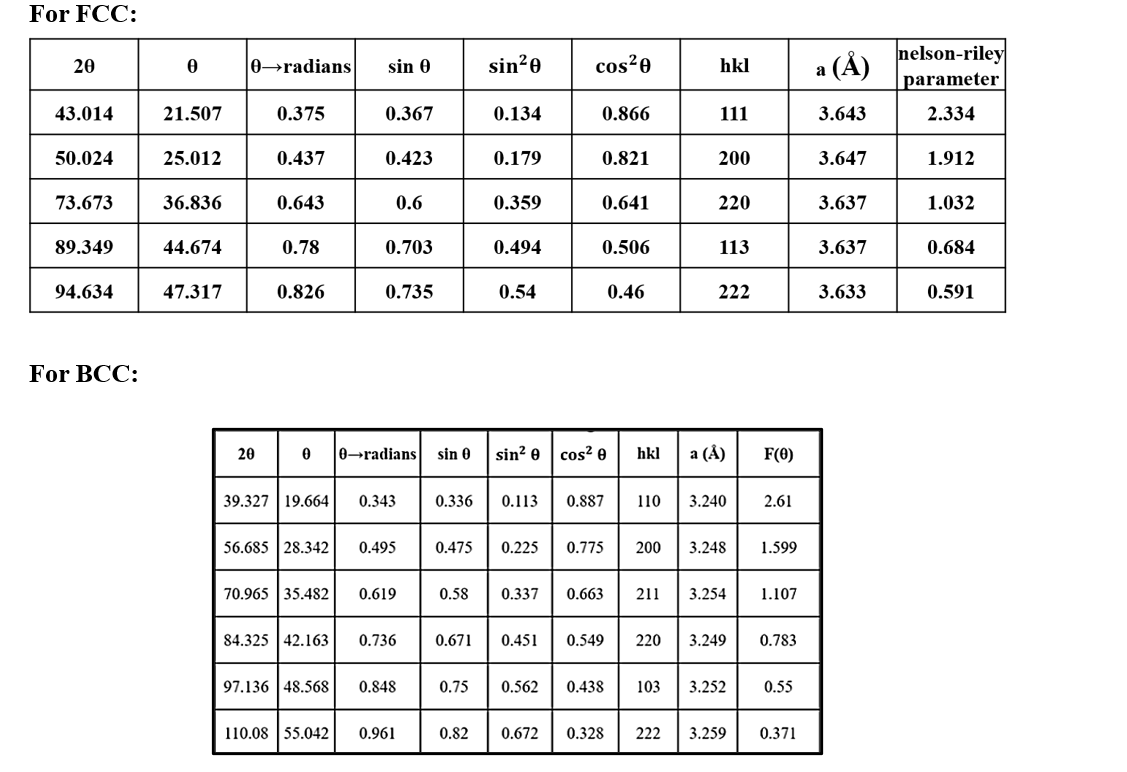
- Plot a versus F(θ) and perform linear fitting of the data obtained.
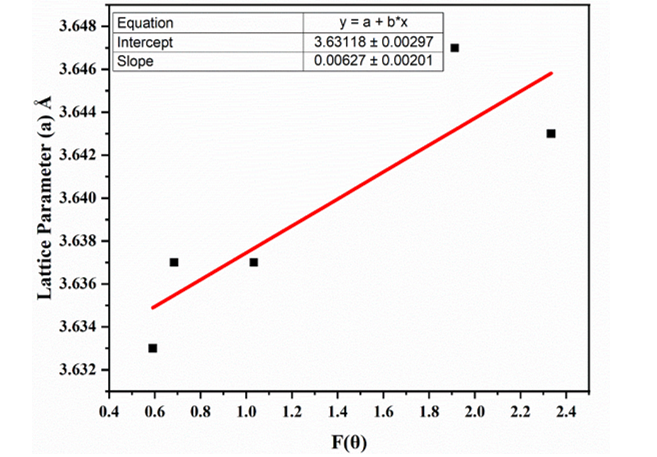
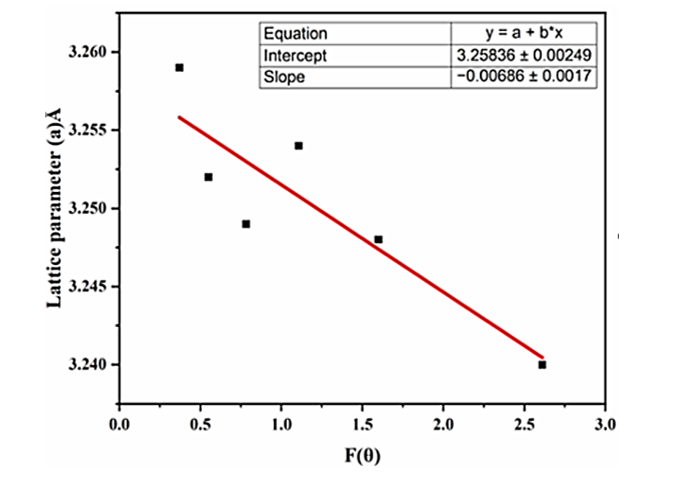
- Extrapolate the best-fit line to F (θ)=0. The y-intercept of the fitted line corresponds to the precise lattice parameter of the material after minimizing systematic errors.
FCC: The below procedure yields a precise lattice parameter for FCC to be 3.631±0.003 Å.
BCC:The below procedure yields a precise lattice parameter for FCC to be 3.2583±0.003 Å.
Simulation Procedure:
Step 1: Select the preferred language (English or Hindi) from the language selection option.
Step 2: Click on the ON button to switch on the machine.
Step 3: Once the machine is turned on, click on the OFF button to stop the machine if required; otherwise, select the specimen.
Step 4: Click on the OPEN button to open the chamber.
Step 5: Click on the CLOSE button to close the chamber.
Step 6: Click on the STANDBY/ON button and set the required voltage and current.
Step 7: Set the start angle and end angle, then specify the step size and scan rate.
Step 8: Click on the START SCAN button and observe the generated graph and observation table.